|
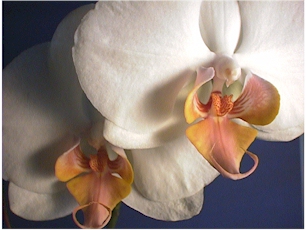
This
phalaenopsis orchid prefers
constant moisture at the
roots.
|
* Some orchids
are grown in
peat-type or
sphagnum moss
mixes. These
tend to dry out
more slowly
than bark mixes
and may not
need to be
watered as
often.
* Orchids in
fine bark will
hold more
moisture
compared to
those in medium
or coarse
bark(which has
more air
space).
|
|
First, most orchids we grow are
epiphytic orchid that in the
wild, grow on trees with roots
exposed. If you're a
greenhouse grower, you can
mount your orchids on
bark to emulate conditions
in nature, but most of us will
be growing orchids in pots
indoors. This is where watering
becomes a problem. Most orchids
receive frequent rainfall
during their growing
season--the roots are wet
thoroughly, but because they
are also exposed to the air dry
quickly, before they are wet
again. In pots, orchids roots
are exposed to less air and do
not dry as quickly. If you
overwater them, the roots end
up rotting and the plant will
also go downhill. Orchid plants
are only as good as their
roots.
There
are three things to keep
in mind in determining how
often to water your
plants.
1.
The type of
orchid. Some orchids
like to be kept moist at all
times, such as phalaenopsis
orchids, while others like to
dry out a bit between watering,
such as
cattleyas.
2.
The light and
temperature. In warmer
brighter conditions(summer)
orchids will need more frequent
watering than in cooler
low-light
conditions(winter).
3.
The type of pot and
growing mix. Plastic
pots retain more water than
clay pots. Larger pots dry out
more slowly than smaller ones.
Some orchid potting mixes
retain more water than
others.
Basically,
water your plants when they
need it, not on some
predetermined frequency such as
once a week. Over time, buy
observing your plants and their
needs, you'll be able to set up
a watering schedule for each
season.
|